
How long does SEO take to show results? If you are asking that question, you have probably already heard a few different answers. Some say three months. Some say a year. Both can be true, depending on what you count as a result and where your website is starting from.
Our honest answer, and the one we give every SEO client before they sign anything, is six to nine months for meaningful movement. Technical fixes and quick wins can show sooner. Revenue-level impact, where organic search becomes a channel your finance team notices, usually takes longer than that and then keeps growing.
This guide explains why, what happens in each phase, what can shorten or lengthen the timeline, and how to tell whether your SEO programme is on track long before the traffic chart turns upward.
How long does SEO take? The short answer is six to nine months
SEO is slow for structural reasons, not because anyone is dragging their feet. Three things have to happen in sequence before rankings move:
-
- Google has to crawl and re-index your changes. On a healthy site this can take days. On a site with crawl problems, duplicate pages or weak internal linking, it can take weeks for a single change to be picked up.
-
- Google has to trust the page enough to test it. New or rewritten pages are typically shown to a small slice of searchers first. If engagement holds up, visibility is widened. If not, the page settles lower.
-
- Authority has to catch up with ambition. For commercial terms with money attached, the pages already ranking have links, history and engagement data. Your page has to earn comparable signals, and links in particular accumulate at the speed of outreach and editorial calendars, not at the speed you want them to.
Put those together and you get a lag of months, not weeks, between doing the work and seeing it rewarded. Anyone promising page-one rankings in thirty days is either targeting terms nobody searches for or planning to use tactics that get sites penalised.
What “results” actually means in SEO
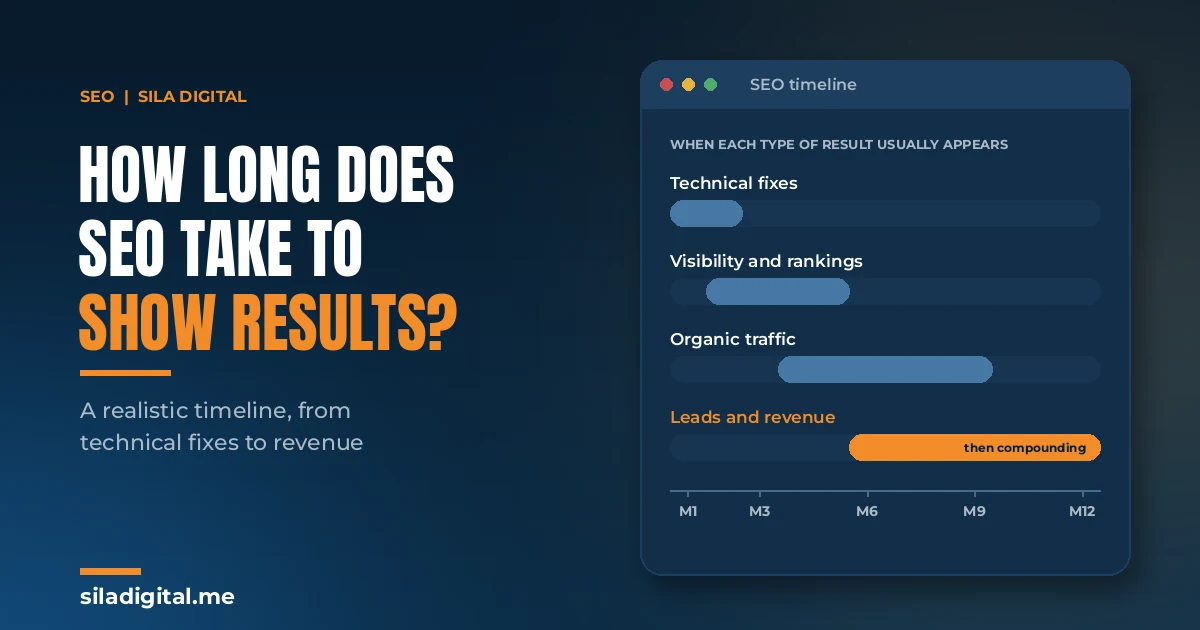
Part of the confusion comes from the word “results”. There are at least four different things people mean by it, and they arrive at different times:
-
- Technical results: more pages indexed, faster load times, fewer errors. Weeks one to eight.
-
- Visibility results: more keywords tracked, rising impressions in Google Search Console, average position improving. Months two to five.
-
- Traffic results: organic sessions climbing month on month. Months four to nine.
-
- Commercial results: leads, demo requests, funded accounts or purchases from organic search. Months six to twelve, then compounding.
If your reporting only looks at the last of these, SEO will look like it is doing nothing for half a year. If it looks at all four, you will see the programme working from the first month.
How long does SEO take, month by month
Exactly how long SEO takes varies, but the shape of a well-run programme is remarkably consistent. Here is what we expect to see on a typical mid-size website with moderate competition.
Months 1 to 2: diagnosis and foundations
This phase is about removing anything that would cap growth later. A full technical audit, keyword research mapped to your services and buyers, and a content plan built around search demand rather than guesswork. Fixes to site speed, indexing, redirects, duplicate content and structured data go in now. You will not see much ranking movement yet, but you will see crawl stats and indexed page counts improve, and the first impressions for new terms start to appear.
Months 3 to 4: early movement
Rewritten money pages begin to rank for long-tail and lower-competition terms. Impressions climb noticeably before clicks do, because pages are being shown on page two and three first. Local visibility, if you have a Google Business Profile, often improves in this window. The first editorial links land in this window too.
Months 5 to 9: meaningful traction
This is the window most clients remember as “when SEO started working”. Commercial terms move from page three to page one. Organic traffic shows a clear upward trend across consecutive months rather than one good week. Leads and sales from organic become visible and attributable.
Months 9 to 12 and beyond: compounding
Authority built for one set of pages begins to help every other page on the site. New content ranks faster than it did at the start, because the domain itself is trusted. The programme shifts from building to expanding: new keyword clusters, new markets, and protecting the positions already won.
What a two-year programme looks like in practice
Our work with Wilson Bradley, a hardware and building supplies retailer competing against far larger incumbents, is a useful reference because it was measured over a long period rather than a single quarter.
Between January 2024 and February 2026 the programme delivered 917 ranking positions gained across 39 tracked commercial keywords, including moves such as “built in kitchen bins” to position one and “kitchen led lights” to position three. Across the full year of 2025, organic search generated over 560,000 sessions and 9,781 organic purchasers, and became the brand’s largest acquisition channel by volume.
The sequence was deliberate: authority building through editorial links, a strategic rewrite of commercial collection pages around search intent, and technical recommendations implemented by the client’s in-house developers. Each layer made the next one more effective. The traffic in year two was built on the foundations laid in the first few months, when the ranking charts looked flat.
The same pattern held for MAAP, a premium cycling apparel brand, where organic search grew to 67% of total traffic as the business scaled four times over, keeping customer acquisition costs in check precisely because the organic engine had been built early.
Seven factors that change the timeline
Your own timeline will sit somewhere on the six-to-nine-month range, or outside it, depending on the following.
-
- Site age and existing authority. A domain with years of history and a healthy link profile can see commercial movement in three to four months. A brand-new site is usually at the longer end, because it has to earn trust from nothing. Starting SEO early on a new site is still the right call: the foundations cost far less to lay correctly than to fix later.
-
- How competitive your terms are. “Forex broker UAE”, “wealth management Dubai”, “dermatologist Dubai” and “buy property in Dubai” are among the most contested searches in the region. Terms like these can take twelve months or more. Less contested long-tail terms around the same topics can rank within weeks and often convert better.
-
- Technical health. Slow pages, index bloat, broken internal linking and poor mobile performance all suppress results from otherwise good content. Fixing them first is why the early months of a programme look quiet on the outside.
-
- Content quality and velocity. One well-researched page a week outperforms ten thin ones. In financial services, trading and healthcare, content also has to demonstrate real expertise and accuracy, because search engines hold these topics to a higher standard.
-
- Link acquisition. Editorial links from relevant publications are still the strongest lever for competitive terms, and the slowest to obtain. A realistic programme plans for a steady monthly cadence rather than a burst.
-
- Implementation speed on your side. This is the factor businesses underestimate most. If technical recommendations wait eight weeks in a development queue, the whole timeline shifts by eight weeks. We build implementation planning into every engagement for this reason.
-
- Compliance review. In regulated industries such as FX and CFD trading, wealth management, insurance and healthcare, every page may need sign-off before publishing. That is right and proper, and it needs to be built into the schedule rather than treated as a surprise.
What you can see sooner
Six to nine months is how long SEO takes to deliver meaningful commercial results. It does not mean nothing happens until then. Early wins we routinely see include:
-
- Technical fixes improving crawl efficiency and Core Web Vitals within the first month.
-
- Google Business Profile optimisation improving map visibility for local searches within weeks, which matters for clinics, real estate agencies and advisory firms serving a specific area.
-
- Long-tail and question-based terms ranking quickly, especially where competitors have ignored them.
-
- A rising impressions line in Search Console, which is the earliest reliable signal that Google is testing your pages for more queries.
Why consistency beats speed
Paid media is a tap: spend money, get traffic; stop spending, lose it the same day. Organic search is an asset: build it once and it keeps delivering, and it is one of the few marketing investments that gets cheaper per lead over time rather than more expensive.
That asset only forms with consistent effort. Stop-start SEO, where a programme runs for three months and then pauses, is the most common way to spend money and see nothing. Each pause lets competitors recover ground and resets the trust-building clock. Content needs refreshing, links need maintaining, and search engines reward sites that keep showing up.
This is why we talk about SEO as a channel to be built rather than a project to be finished.
How to tell whether SEO is working before the traffic arrives
If you are three or four months in and want to know whether the investment is working, look at leading indicators rather than lagging ones. A healthy programme will show most of these moving:
-
- Indexed pages and crawl stats improving in Google Search Console.
-
- Total impressions trending up, even if clicks have not followed yet.
-
- Keywords tracked in the top 100 growing in SEMrush or your rank tracker, and average position improving.
-
- Referring domains increasing steadily, with links from relevant and reputable sites.
-
- Pages cited in AI search results (ChatGPT, Google AI Overviews, Gemini, Perplexity), which increasingly act as a first-touch discovery layer for considered purchases.
-
- Engagement on organic sessions in GA4: time on page, pages per session and key events holding up as traffic grows.
If all of these are flat after four months, something is wrong with the programme. If they are moving, the traffic and leads are on their way, even if the headline chart has not caught up.
Frequently asked questions
Can SEO results be seen in three months?
Some can. Technical improvements, click-through gains from better titles, local map visibility and long-tail rankings often appear within three months. Page-one rankings for competitive commercial terms, and the traffic and leads that come with them, usually take six to nine months.
How long does SEO take for a new website?
A new website typically sits at the longer end of the range, often nine to twelve months for commercial terms, because it has no history or authority to draw on. The advantage of starting early is that the technical and content foundations are laid correctly from day one.
Why has my SEO stopped working after six months?
The usual causes are a pause in content or link building, a technical change that affected crawling, an algorithm update, or competitors investing more aggressively. A review of Search Console data alongside your rank tracking will normally identify which one it is.
Is SEO faster than Google Ads?
No. Google Ads can deliver traffic the same day, which is why the two work best together. Ads bring leads while SEO builds a lower-cost, long-term channel underneath. If budget is limited, sequencing them sensibly matters more than choosing one.
Does SEO ever finish?
Not really. Once a site is ranking well, the work shifts from building to expanding and protecting: new keyword clusters, new markets, refreshed content and ongoing authority building. The effort required to maintain positions is lower than the effort to win them, but it does not drop to zero.
Want a realistic timeline for your own website?
Every site starts from a different place. On a discovery call we will look at your current visibility, your competition and your technical health, and tell you honestly where the biggest search opportunities are and how long they will take to capture.