
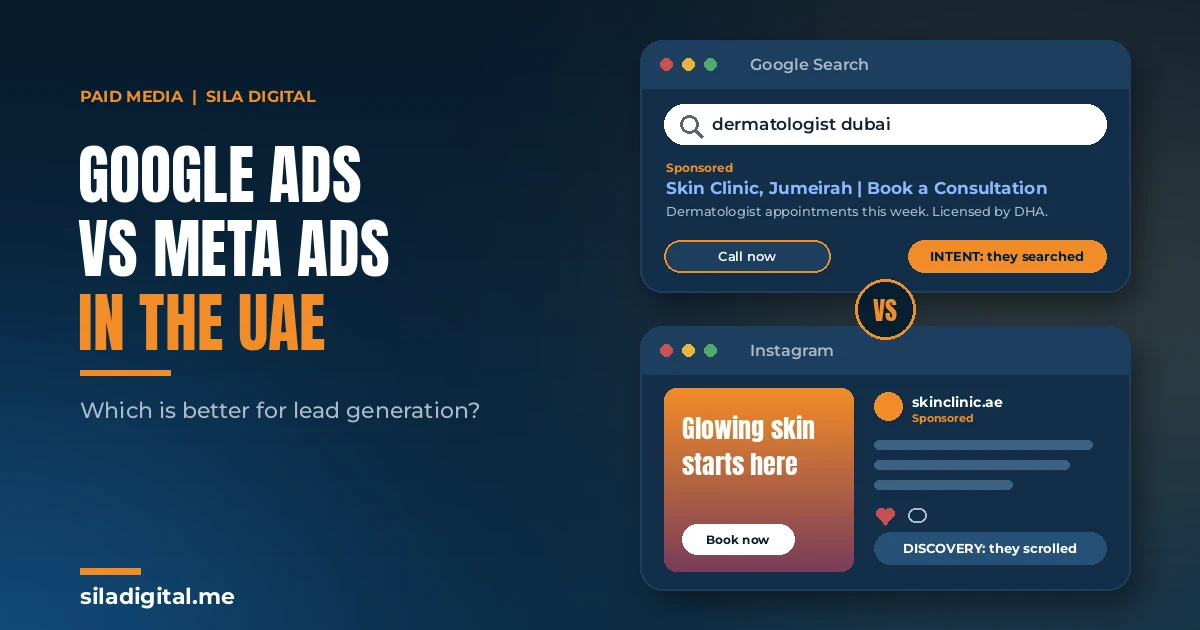
Google Ads vs Meta Ads in the UAE is the question every marketing lead asks when the budget is limited and the pipeline is not. The honest answer is that they are not competing for the same job. Google captures demand that already exists. Meta creates demand that did not exist five minutes ago. Which one is “better” depends on what your buyer does before they buy, what a closed deal is worth to you, and how quickly your team can follow up.
This guide sets out the differences that matter for lead generation, what each platform typically costs, where each one wins in the UAE market, and a simple way to decide where the next dirham of budget should go.
The core difference: intent versus interruption
Someone who types “forex broker UAE” or “dermatologist Dubai” into Google has a need and is looking for a provider. Google Ads lets you appear at that exact moment. The lead is warm, often ready to talk, and usually more expensive to reach because every competitor wants that same moment.
Someone scrolling Instagram or Facebook was not looking for you. Meta Ads interrupt with a message aimed at a person who matches an audience profile. The lead is cheaper, earlier in the decision, and more likely to need nurturing before they buy. Volume is easier; quality takes more work.
Neither is a flaw. They are different stages of the same funnel, and most businesses that treat them as rivals are measuring both with the wrong yardstick.
What they cost in the UAE
The UAE is one of the most expensive search markets in the world, and the spread between sectors is wide. Published 2026 UAE benchmarks put Google Search clicks anywhere from AED 2 to 8 for e-commerce and retail up to AED 20 to 45 for real estate and AED 25 to 50 for financial services and legal, with off-plan property and corporate law terms passing AED 100 a click. Meta clicks are a fraction of that because Meta sells attention, not intent.
Cost per lead follows the same pattern. On Google, qualified leads in the UAE’s competitive categories typically land between AED 150 and 500, with real estate and financial services at the upper end and clinics around AED 80 to 250 per booked appointment. On Meta, published UAE ranges run roughly AED 40 to 250 per lead across sectors, with B2B at the higher end.
| Indicative 2026 UAE ranges | Google Search Ads | Meta lead campaigns |
|---|---|---|
| Cost per click | AED 2 to 50 by sector; AED 100+ for off-plan property and corporate law | Typically under AED 10 |
| Cost per lead | AED 150 to 500 in competitive sectors; AED 80 to 250 for clinic bookings | AED 40 to 250 across sectors |
| Typical lead intent | High: active search | Lower: interrupted browsing |
| Typical follow-up need | Fast response, less nurture | Fast response, more nurture |
Two cautions. First, these are ranges, not prices; your own numbers depend on keyword, season and how well the account is run. Second, cost per lead is the wrong number to optimise. A Meta lead at AED 60 that never closes costs more than a Google lead at AED 300 that does. The metric that settles the argument is cost per client, and only a connected CRM can tell you that.
Where Google Ads wins in the UAE
- High-intent, high-value services. Brokerages, advisory firms, law firms, clinics and B2B services where the buyer searches by name of need. The click is expensive because it is worth it.
- Local service searches. “Near me” and area-based queries, where Google’s map and search placements reach people ready to call.
- Short sales cycles. When a lead can become a customer within days, paying more for intent is efficient.
- Measurable keywords. Search gives you the query itself, which makes qualification and negative keyword control precise.
The constraint in regulated sectors is ad policy. Financial services and healthcare campaigns on Google require certifications and compliant landing pages, which we cover in our guide to PPC for financial services in the UAE.
Where Meta Ads win in the UAE
- Visual, considered products. Property launches, aesthetic treatments, e-commerce and anything a photo or video sells better than a headline.
- Audience building. Reaching people who match your best customers before they search, then retargeting them when they do.
- Volume at a lower entry cost. Smaller budgets go further, which matters for brands testing a new market or offer.
- WhatsApp-led conversion. Click-to-WhatsApp ads suit the way UAE customers prefer to enquire, especially in real estate and healthcare.
The constraint is lead quality. Instant forms are easy to submit and easy to forget. Without qualifying questions and follow-up within minutes, Meta leads go cold faster than Google leads do.
Sector by sector
Financial services and FX/CFD brokers
Google for account openings from people actively comparing brokers; Meta for education-led content, webinar registrations and retargeting. Both platforms restrict financial promotion, so compliance review and jurisdiction targeting are part of the setup, not an afterthought.
Real estate
Meta for off-plan launches, interest lists and video walkthroughs; Google for buyers searching specific communities and property types. Speed to first call decides the outcome on both.
Clinics and healthcare
Google for treatment and specialist searches, where intent is highest; Meta for awareness and before-the-search education within the platform’s health advertising rules. Booking confirmation on WhatsApp improves show rates from either source.
E-commerce
Google Shopping and search for product intent; Meta for discovery, retargeting and repeat purchase. Most mature stores run both, with Meta larger by spend and Google larger by return per click.
A simple way to decide
- Start with how your buyers find you. If they search for your category by name, Google first. If they need to be shown, Meta first.
- Check what a client is worth. High lifetime value justifies Google’s higher cost per lead. Lower value needs Meta’s volume.
- Be honest about follow-up. If your team cannot respond within the hour, Meta’s cheaper leads will mostly be wasted. Fix speed to lead before scaling either platform.
- Run both at small scale for 60 days. Judge on cost per qualified lead and cost per client, not cost per lead.
- Let the data move the budget. Shift spend monthly toward the platform producing closed business, not the one producing the busiest dashboard.
Five mistakes we see in UAE accounts
- Judging Meta by Google’s yardstick. Meta leads are earlier in the decision. Measured on same-week conversion they always look worse; measured on cost per client after nurture they often do not.
- No negative keywords. Search accounts paying for “free”, “jobs”, “course” and competitor names alongside real buyers.
- Instant forms with nothing qualifying. The cheapest lead on the platform, and the least likely to answer the phone.
- One landing page for everything. The ad promises one thing, the page talks about six. Match the page to the campaign.
- Broad targeting in regulated categories. Lookalike expansion and broad geography quietly reach markets the licence does not cover.
How we approach it
We rarely recommend one platform in isolation. The combinations that work are usually Google capturing intent while Meta builds the audience that feeds it, with retargeting connecting the two and a single CRM showing which campaign produced the client. Tracking is set up first, because without it the platform comparison is a matter of opinion.
Cost ranges are compiled from UAE benchmark data published by local advertisers and agencies during 2026 and from our own campaign experience. They vary widely by keyword, season (Ramadan, Eid, Dubai Shopping Festival) and account quality; treat them as orientation, not targets.
Frequently asked questions
Which is cheaper for leads in the UAE, Google Ads or Meta Ads?
Meta usually produces cheaper leads; published UAE ranges put Meta leads at roughly AED 40 to 250 against AED 150 to 500 on Google in competitive sectors. Google leads tend to be further along in the decision, so the cost per client is often closer than the cost per lead suggests.
Can a small business run both platforms?
Yes, and small budgets often learn faster by running both at low spend for two months than by committing everything to one. The deciding number is cost per qualified lead, which needs tracking from the start.
Do Google Ads or Meta Ads work better for financial services in the UAE?
Google tends to win for account openings from active searchers; Meta works for education, webinars and retargeting. Both restrict financial promotion, so certification, disclaimers and compliant landing pages apply either way.
Why are my Meta leads low quality?
Usually because the offer attracts the wrong person, the form asks nothing qualifying, or nobody follows up within the hour. More budget scales those problems rather than fixing them.
How long before I know which platform is working?
Give each platform at least 60 days with consistent tracking. Judge on qualified leads and closed business over that period rather than week-to-week cost per lead, which moves with seasonality and learning phases.
Not sure where the next dirham should go?
On a discovery call we will look at how your buyers actually find you, what your tracking can and cannot tell you, and which platform is likely to produce clients rather than leads.
Book a discovery callPrefer email? Write to hello@siladigital.me.