
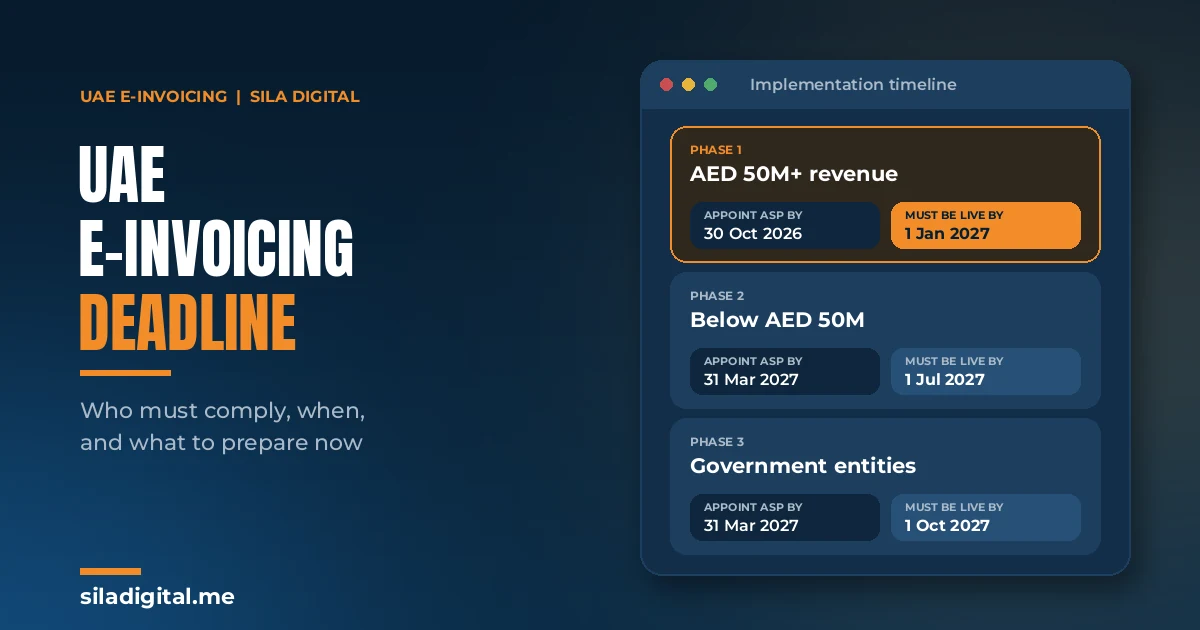
The UAE e-invoicing deadline is not one date. It is a phased timetable, and which date applies to you depends on your annual revenue. Businesses with revenue of AED 50 million or more must be issuing and receiving e-invoices from 1 January 2027. Every other VAT-registered business follows on 1 July 2027, and government entities on 1 October 2027.
Two of those dates are closer than they look. Large businesses were required to appoint an Accredited Service Provider (ASP) by 30 October 2026, and their go-live is ten weeks away. Smaller businesses have until 31 March 2027 to appoint their ASP, which sounds comfortable until you count how long an ERP integration, data mapping and testing actually take.
This guide sets out the UAE e-invoicing deadline for each phase, who is in scope, what changes on the day, what the penalties are, and what finance and IT teams should be doing now.
Last updated: 23 October 2026. We will update this page as the Ministry of Finance publishes further decisions.
The UAE e-invoicing deadlines at a glance
The timetable is set by Ministerial Decision No. 244 of 2025, with a May 2026 amendment that extended the first ASP appointment deadline from 31 July to 30 October 2026 while keeping the go-live date unchanged.
| Phase | Who | Appoint an ASP by | E-invoicing mandatory from |
|---|---|---|---|
| Pilot and voluntary | Invited working group; any business may opt in | Not applicable | 1 July 2026 (voluntary) |
| Phase 1 | Businesses with annual revenue of AED 50 million or more | 30 October 2026 | 1 January 2027 |
| Phase 2 | Businesses with annual revenue below AED 50 million | 31 March 2027 | 1 July 2027 |
| Phase 3 | Government entities | 31 March 2027 | 1 October 2027 |
Once all three phases are complete, any newly in-scope business or entity must appoint an ASP and implement the system as a matter of course. There is no standing exemption for being new or small.
Who is in scope
The Electronic Invoicing System applies to business-to-business (B2B) and business-to-government (B2G) transactions in the UAE, including transactions involving non-resident parties. In practice that means VAT-registered businesses that issue or receive tax invoices and credit notes to other businesses or to government bodies.
Business-to-consumer (B2C) transactions are not part of the current phases. Based on how similar mandates have unfolded elsewhere in the GCC, it would be prudent to assume they may be added later rather than to build a solution that cannot accommodate them.
The revenue threshold that decides your phase is annual revenue, not VAT turnover alone, so groups with several entities should check each entity against the threshold separately and confirm the position with their tax adviser.
What actually changes on your deadline
E-invoicing in the UAE replaces the PDF invoice as the legal document with a structured XML file in the PINT AE format, the UAE profile of the Peppol international invoice standard. That file is not emailed to your customer. It is transmitted through your ASP, over the Peppol network, to your customer’s ASP, and the tax data is reported to the Federal Tax Authority in near real time. The model is often called “five-corner”: you, your ASP, the FTA, your customer’s ASP, and your customer.
From your applicable date, several obligations apply at once:
-
- Every in-scope invoice and credit note must be issued in PINT AE format through your ASP, within 14 days of the transaction.
-
- You must also be able to receive e-invoices through your ASP. Many businesses focus on issuing and forget that their suppliers’ invoices will arrive the same way.
-
- Record-keeping, data-change notifications and other operational rules are set out in the Ministry of Finance decisions and have been amended during 2026. Confirm the current requirements with your ASP or tax adviser as part of implementation.
A PDF can still be sent to the customer for convenience, but it is no longer the invoice. The XML is.
What the ASP deadline means in practice
An Accredited Service Provider is a technology provider approved by the Ministry of Finance to connect businesses to the Peppol network, validate invoices against PINT AE, and report to the FTA. You cannot connect to the FTA directly; every in-scope business, as issuer and as recipient, must go through an ASP. The Ministry maintains a list of pre-approved providers, which had grown to more than forty by mid-2026.
“Appointing” an ASP means more than signing a contract. By the ASP deadline you should be registered on the network through your provider and capable of receiving e-invoices. That is why the deadline sits two to three months ahead of the go-live date: the remaining time is for integrating your systems, mapping your data and testing.
When choosing a provider, the questions that matter most are practical ones. Does it have a ready connector for your ERP or accounting system, or will the integration be built from scratch? Has it handled Peppol implementations in other markets? What does onboarding and testing support look like? How does it handle multiple entities, currencies and credit notes? Price matters, but a cheap provider that leaves the integration entirely to you is rarely the cheaper option.
Penalties for missing the UAE e-invoicing deadline
The penalty framework is designed to make delay more expensive than compliance. Failing to implement the system or to appoint an ASP within the prescribed timeline carries a penalty of AED 5,000 for each month, or part of a month, of delay. Other penalties apply to operational breaches; your tax adviser can confirm the current schedule. General VAT penalties under Cabinet Decision No. 40 of 2017, as amended, continue to apply alongside these.
No extension has been announced for any go-live date. The only extension to date was for the Phase 1 ASP appointment, and it did not move the 1 January 2027 implementation date.
Why the real work is the integration, not the signature
The ASP handles transport, validation and reporting. It does not fix your data. Every invoice you issue has to leave your ERP or accounting system with the fields PINT AE requires, populated correctly, every time. The UAE specification contains well over a hundred data elements, and the ones that cause problems are usually mundane: customer tax registration numbers that are missing or outdated, inconsistent item codes, VAT categories that were never set up properly because a human used to fix them on the PDF, and credit notes that do not reference the original invoice.
That is why readiness takes months rather than weeks, and why e-invoicing is a finance and IT project jointly rather than a tax team task. The sequence that works is: assess which systems issue and receive invoices, clean the master data that feeds them, map each required field to its source, build or configure the connector to your ASP, test against real invoices in the pilot environment, then go live with monitoring in place for rejections.
Businesses running more than one system, such as an ERP for one entity and an accounting package for another, or a point-of-sale system that generates B2B invoices, need to bring every issuing system into scope. The deadline applies to the invoice, not to the system it came from.
What to prepare now, by phase
If your revenue is AED 50 million or more
Your ASP should be appointed and you should be inside the integration phase. With ten weeks to go, the priorities are data mapping completed and signed off, test invoices exchanged end to end with at least one customer and one supplier, exception handling agreed (what happens when an invoice is rejected), and finance staff trained on the new issue-and-receive workflow. If any of these has not started, treat it as urgent.
If your revenue is below AED 50 million
Your ASP appointment deadline is 31 March 2027 and your go-live is 1 July 2027. Working backwards from July, you need to be testing by April or May, which means the integration should be built by March, which means ASP selection and a readiness assessment belong in the next few weeks. Businesses that leave ASP selection until March will find providers busy and implementation slots scarce.
For every business
-
- Confirm your phase: calculate annual revenue per entity and document the result.
-
- List every system that issues or receives B2B or B2G invoices.
-
- Audit master data: customer and supplier TRNs, addresses, item codes and VAT categories.
-
- Shortlist ASPs on ERP connectors, Peppol experience and support, not price alone.
-
- Assign an owner from finance and one from IT; this fails when it belongs to only one of them.
-
- Plan for receiving as well as issuing, including how incoming e-invoices will flow into approvals.
Where Sila Digital fits
Our team works on the part of e-invoicing integration that sits between your business systems and your ASP: readiness assessment, data mapping to PINT AE, the connector between your ERP or accounting software and the provider, testing, and go-live support. We have delivered e-invoicing integrations in and outside the UAE, so we know where the data problems hide before the first rejection tells you.
If you are not sure which phase you fall into, or you have appointed an ASP and are unsure what happens next, a short readiness conversation is the fastest way to find out how much work is actually in front of you.
Frequently asked questions
What is the UAE e-invoicing deadline?
It is phased. Businesses with annual revenue of AED 50 million or more must comply from 1 January 2027, businesses below that threshold from 1 July 2027, and government entities from 1 October 2027. Each phase has an earlier deadline to appoint an Accredited Service Provider.
Has the UAE e-invoicing deadline been extended?
Only the Phase 1 deadline to appoint an ASP was extended, from 31 July 2026 to 30 October 2026. The mandatory go-live dates have not changed.
Does e-invoicing apply to small businesses in the UAE?
Yes. Businesses with annual revenue below AED 50 million are in Phase 2, with an ASP appointment deadline of 31 March 2027 and mandatory e-invoicing from 1 July 2027.
Can I send e-invoices directly to the FTA without an ASP?
No. Every in-scope business must appoint an Accredited Service Provider and exchange invoices through it. Direct connection to the FTA is not available.
Can I still send my customers a PDF invoice?
You can send a PDF for convenience, but the legal invoice is the structured PINT AE file transmitted through your ASP. The PDF on its own no longer satisfies the requirement.
What is the penalty for missing the e-invoicing deadline?
Failing to implement the system or appoint an ASP on time carries a penalty of AED 5,000 per month or part month of delay, with separate penalties for other breaches such as late notification of data changes.
Find out how ready you are
Book a discovery call and we will walk through your systems, your phase and your data, and give you a realistic picture of the integration work between now and your deadline.