
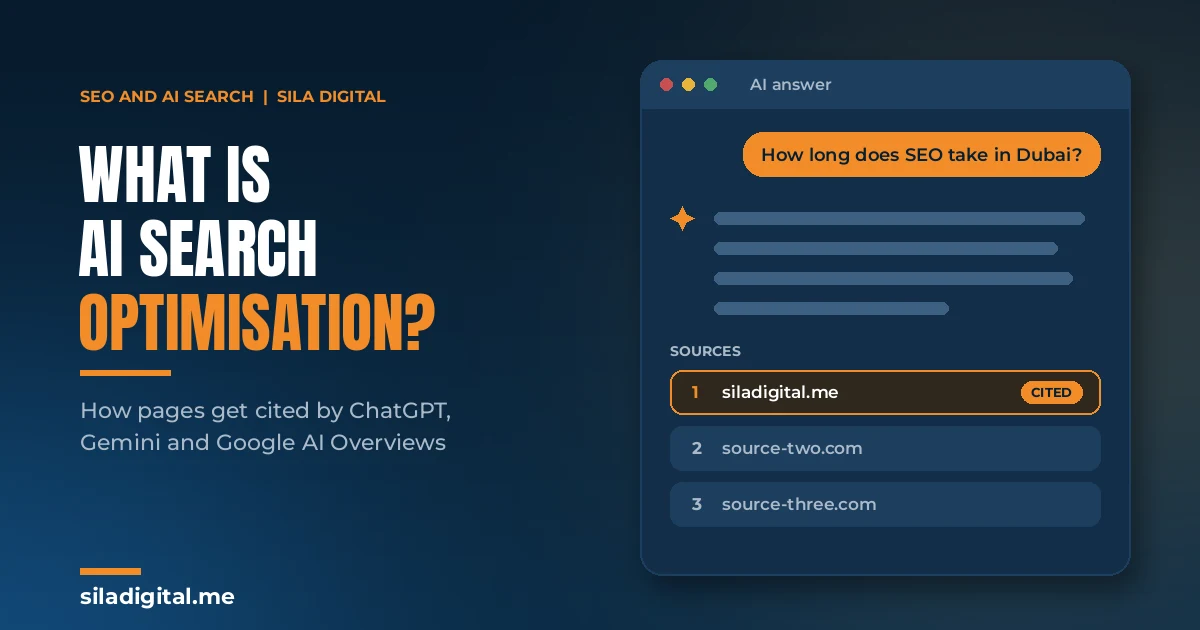
AI search optimisation is the practice of structuring your content so that AI assistants and AI-powered search features can understand it, trust it and cite it when they answer a question. It goes by several names: answer engine optimisation (AEO), generative engine optimisation (GEO), AI visibility. The goal is the same under each: when someone asks ChatGPT, Gemini, Perplexity or Google’s AI Overviews a question your business can answer, your page is one of the sources behind the reply.
This guide explains how these systems choose what to cite, what that means for the way you write and structure pages, how to measure whether it is working, and what the results look like in practice, using two of our own client programmes as evidence.
Why it matters now
For a growing share of considered purchases, the first question is no longer typed into a search box. It is asked in a chat window. A buyer evaluating a broker, comparing clinics, or researching a software category increasingly gets a synthesised answer with a handful of cited sources. If your business is not among them, you are invisible at the moment the shortlist is formed.
Google’s AI Overviews put the same mechanism at the top of ordinary search results. The organic listings are still there, but the answer above them, and the sources it cites, now shape which links get read.
How AI assistants decide what to cite
No engine publishes its selection logic, and no method guarantees a citation. But the patterns are consistent enough across engines to act on.
- They start from pages that already rank. AI search features draw heavily on conventional search indexes. Pages with authority, relevance and good rankings are far more likely to be retrieved in the first place. AI search optimisation is built on SEO, not instead of it.
- They prefer direct answers. A page that answers a specific question in its first paragraph, in plain language, is easier to quote than one that builds up to it over eight hundred words.
- They reward clear structure. Descriptive headings, short sections, lists and tables help a model extract the relevant part of a page without ambiguity.
- They favour verifiable, specific claims. Numbers, dates, named sources and precise definitions are cited more often than generalities.
- They look for entity clarity. Who wrote this, what organisation stands behind it, and what the page is about should be unambiguous, on the page and in structured data.
What this means for how you write
Answer first, then explain
Put the direct answer at the top of the page or section, then the detail, then the proof. Readers who want the short version get it; engines get something quotable. This is also what good writing for people looks like.
One question per section
Headings that are real questions or precise statements (“How long does SEO take?”, “Who must comply with UAE e-invoicing?”) map directly to the queries people type and the prompts they ask. Vague headings do not.
Be specific and citable
“Our client’s organic traffic grew” is not citable. “Organic search delivered 560,899 sessions in 2025” is. Precision is what gets quoted, and it is also what builds trust with a human reader.
Keep the technical foundations clean
Crawlability, fast pages, canonical URLs and schema markup (Organisation, Article, Product where relevant) all affect whether a page is retrieved and understood. FAQ-style question-and-answer content remains useful for this purpose even though Google no longer displays FAQ rich results in search.
Demonstrate expertise, especially in regulated topics
For financial services, trading, healthcare and legal subjects, engines hold content to a higher standard of accuracy and authorship. Named authors, credentials and references matter more here than anywhere.
How to measure AI visibility
Three measures matter, and they are now trackable in mainstream SEO tools:
- Mentions: how often your brand appears in AI-generated answers for prompts in your category.
- Cited pages: which specific URLs are being used as sources.
- Visibility score by engine and market: a relative measure of presence in ChatGPT, Gemini, AI Overviews and Perplexity, by country.
Track these monthly alongside organic traffic and leads, and connect them to what the business actually sees. A cited page that brings no enquiries is a vanity metric; a cited page that appears in a buyer’s shortlist research is a channel.
What the results look like
Two programmes from our own work illustrate the method. Both were SEO engagements first; the AI visibility followed from the way the content was built.
MAAP, a premium cycling apparel brand, recorded more than 1,700 AI mentions across ChatGPT, Google AI Overviews, AI Mode and Gemini, with 642 pages cited in AI-generated responses and an AI visibility score of 56 worldwide (60 in its primary market, Australia). Organic search accounts for 67% of the brand’s total traffic.
Billy J, an Australian fashion retailer, recorded more than 3,100 AI mentions and 968 cited pages across the same engines, among the highest in its category, from content built with answer-first formatting, comparison pages, question-and-answer sections and entity-optimised product descriptions.
In both cases the AI results were an output of the same work that produced the rankings: technical foundations, content written to answer real questions, and authority earned from relevant publications. There was no separate “AI trick”.
A worked example: rewriting one page
Take a typical service page for a wealth advisory firm. Before: a hero headline (“Your financial future, our priority”), four paragraphs about the firm’s values, a list of services, and a contact form. Nothing on the page answers a question anyone types.
After: the page opens with the question the firm is most often asked (“How does a fee-only adviser in Dubai charge?”) and answers it directly in two sentences. A short section follows for each of the next four questions clients ask, each with a precise answer, a number where one exists, and a link to the detailed page. The adviser’s name, credentials and regulator appear near the top, with Organisation and Article markup behind the page. The contact form stays where it was.
The page is now useful to a human, quotable by an engine, and clearer to search. Nothing about it is a trick; it is the page the firm should have written in the first place.
What AI search optimisation is not
- It is not a replacement for SEO. Pages that do not rank are rarely retrieved.
- It is not keyword stuffing for chatbots. Engines penalise the same manipulation search engines do.
- It is not guaranteed. The best method raises the probability of being cited; nothing makes it certain.
- It is not a one-off. Engines change, competitors improve, and content that stops being refreshed stops being cited.
Where to start
- Pick the ten questions your buyers ask most, in their words.
- Check whether your site answers each one directly, in one place, near the top of a page.
- Rewrite or create those pages answer-first, with specific, verifiable detail.
- Fix the technical basics and add Organisation and Article schema.
- Measure mentions and cited pages monthly, and keep refreshing what gets cited.
Frequently asked questions
What is the difference between AEO, GEO and AI search optimisation?
They describe the same discipline from slightly different angles: answer engine optimisation emphasises direct answers, generative engine optimisation emphasises generative AI engines, and AI search optimisation is the umbrella term. In practice the methods overlap almost completely.
Can you guarantee a citation in ChatGPT or Google AI Overviews?
No, and anyone who says they can should be treated with caution. The method raises the likelihood of being cited by making content easy to retrieve, understand and trust. Results vary by topic, competition and engine.
Does FAQ schema still matter?
Google stopped showing FAQ rich results in May 2026, so the search-appearance benefit is gone. Clear question-and-answer content still helps engines understand a page and still helps readers, which is why we continue to use it without expecting a rich result.
Do I need separate content for AI search?
Usually not. Well-structured, answer-first, specific content serves both conventional search and AI engines. The exception is a small set of comparison or definition pages that may be worth creating specifically because they match how people prompt.
How long does AI search optimisation take?
Because it depends on ranking and authority, it follows the same timeline as SEO: early signals in a few months, meaningful presence in six to nine, and compounding from there.
Want to know how visible you are in AI search today?
On a discovery call we will show you where your brand currently appears in AI-generated answers, which competitors are being cited instead, and which pages are closest to earning a citation.
Prefer email? Write to hello@siladigital.me.